Set up your trading infrastructure
Before you place a single trade, you need a secure, fast connection to the Solana network. Speed is the difference between catching a breakout and watching someone else profit. This section walks you through the three pillars of your setup: a reliable wallet, sufficient SOL for gas, and a high-performance RPC endpoint.
Download Phantom or Solflare from their official websites. These are the industry standards for Solana interactions. Avoid third-party app stores or unofficial browser extensions, which may be compromised. Once installed, create a new wallet and write down your 12-word recovery phrase on paper. Never store this digitally. This phrase is the only way to recover your funds if you lose access to your device.
Solana transactions require SOL for gas fees, not the memecoin itself. Transfer SOL from a centralized exchange like Coinbase or Binance to your wallet address. Keep a small buffer of SOL (0.05–0.1 SOL) separate from your trading capital to ensure you can always pay for gas, even during network congestion.
Free public RPC nodes are often rate-limited and slow, causing failed transactions when you need speed. Subscribe to a premium provider like Helius, QuickNode, or Triton. Connect this endpoint to your wallet or trading bot. This ensures your trade requests reach the network instantly, reducing the risk of slippage and front-running.
With your wallet secured and funded, and a fast RPC node active, you are ready to begin trading. The next step is identifying which memecoins have the highest potential for gains.
plan around the on-chain data jungle
Screenshots from Telegram bots or DEX screenshots are easily faked. To trade Solana memecoins safely, you need to verify the contract directly on the blockchain. On-chain data doesn't lie, but it can be noisy. You need the right tools to separate signal from the thousands of new tokens minted every day.
Think of on-chain explorers as the DNA sequencer for a token. Before you buy, you are checking for mutations—like mint authority that hasn't been revoked or liquidity that can be pulled at any moment. This process moves you from gambling on a rumor to trading on verified facts.
Compare Data Aggregators
Different aggregators offer different layers of insight. Some focus on speed, others on safety metrics. Use this comparison to pick the right tool for your specific check.
| Tool | Primary Use | Key Strength | Limitation |
|---|---|---|---|
| Solscan | Basic Verification | Official explorer; shows raw tx history and holder distribution | No built-in scam detection or safety scores |
| DexScreener | Price Action Tracking | Real-time charts and liquidity tracking across all DEXs | Does not verify contract safety or mint authority status |
| RugCheck.xyz | Safety Auditing | Automated risk scoring for mint authority, freeze authority, and liquidity lock | Does not provide live price charts or trading execution |
| Birdeye | Market Overview | Aggregates data from multiple DEXs with strong filtering options | Premium features required for advanced whale tracking |
Start with RugCheck.xyz or Solscan to verify the contract. Paste the token address into these tools. Look specifically for "Mint Authority" and "Freeze Authority." If these are not revoked, the developer can mint infinite tokens or freeze your wallet. This is the single most common way new traders lose everything.
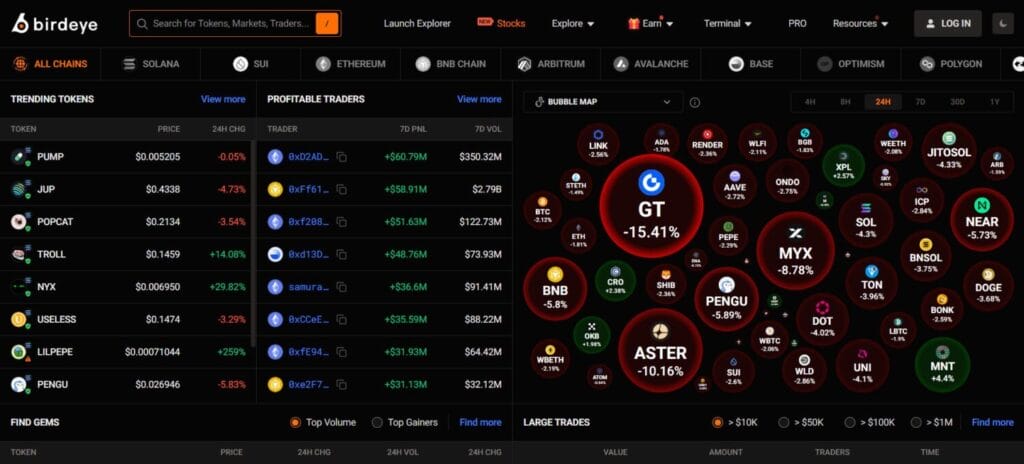
Once safety is confirmed, switch to DexScreener or Birdeye to track volume. Look for organic buy-and-sell patterns, not just a single large pump. If you see a massive green candle with no corresponding volume increase, it is likely a bot-driven pump designed to lure in late buyers.
Execute trades with speed and precision
Buying and selling Solana memecoins requires more than just having SOL in your wallet; it demands a workflow that prioritizes speed and cost control. The difference between a profitable trade and a rekt position often comes down to the tool you use to execute the swap. Standard decentralized exchanges (DEXs) like Jupiter or Raydium are reliable for basic transactions, but they can be sluggish during high-volatility events.
For serious trading, you need terminal tools that allow for pre-set slippage, priority fees, and one-click execution. This section outlines the workflow for executing trades efficiently, distinguishing between standard swaps and advanced terminal setups.

Before you can buy any memecoin, you need SOL in a self-custody wallet like Phantom or Solflare. Transfer SOL from an exchange like Coinbase or Binance to your wallet address. Ensure you keep a small buffer (0.05–0.1 SOL) for transaction fees, as Solana fees are low but not zero.
Navigate to a DEX aggregator like Jupiter (jup.ag) or a specialized terminal like Trojan or BonkBot. Connect your wallet. For standard swaps, Jupiter is the default choice due to its superior routing. For faster execution with custom slippage, consider a Telegram-based bot or a dedicated trading terminal that integrates with Solana’s transaction queue.
This is the most critical step. Memecoins have high volatility. Set your slippage tolerance appropriately—typically 1–5% for established tokens, but up to 15–20% for newly launched coins with high price impact. Always enable "Priority Fees" (or "Tip") to ensure your transaction is processed quickly during network congestion. Without this, your trade may fail or get front-run.
Enter the token contract address (CA) and the amount of SOL you wish to spend. Double-check the token CA to avoid scams. Click "Swap." Monitor the transaction status in your wallet. If the transaction fails due to slippage, adjust the percentage and retry. For sells, the process is identical: select the token, set slippage, and confirm the transaction.


![AINOPE USB to USB C Cable [2-Pack, 6.6ft] 3.1A Type C Charger Fast Charging, Right Angle USB C Cable for iPhone 17 Carplay Cable, Galaxy S10+ S10 S9, Note 10 9, LG V30, Moto, iPhone 16 15 Charger Cord](https://m.media-amazon.com/images/I/71slGPTBJ9S._AC_UY654_QL65_.jpg)
As an Amazon Associate, we may earn from qualifying purchases.
The key to successful execution is discipline. Never trade without a clear entry and exit strategy. Use limit orders where possible to avoid slippage, and always verify the contract address on a block explorer like Solscan before swapping. Speed is essential, but accuracy is paramount.
Avoid common rug pulls and scams
Solana memecoin trading is essentially PvP. The volume moves fast, new contracts launch daily, and the margin for error is slim. Before you commit capital, you need to verify that the contract isn’t rigged to steal your funds or dump on you. This isn’t about finding the next 100x gem; it’s about ensuring you aren’t the exit liquidity.
Check mint and freeze authorities
The most critical step is verifying the token’s authorities. In Solana, "mint authority" allows the creator to print more tokens, diluting your holdings to zero. "Freeze authority" lets them freeze your wallet, preventing you from selling or transferring your assets.
Use a block explorer like Solscan or a dedicated contract auditor. Look for the "Mint Authority" and "Freeze Authority" fields. If these are not set to the "Burned" or "Revoked" state, walk away. A legitimate project will have burned these authorities immediately after launch. If the creator retains control, they can rug pull at any moment.
Warning: Honeypots are rampant on Solana. These are contracts designed to let you buy but block you from selling. Always simulate a sell transaction before buying. If the simulation fails with a "sell not allowed" error, the contract is malicious.
Identify honeypots and liquidity locks
Even with revoked authorities, a contract can still be a honeypot. The developer might have coded a blacklist or a high tax on sells. To test this, use a tool like RugCheck or DexScreener’s contract analysis features. Look for:
- High sell taxes: Taxes above 5-10% on sells are a major red flag.
- Blacklisted addresses: Ensure your wallet isn’t on a blacklist.
- Liquidity pool locks: Check if the liquidity is locked. If the LP tokens are unlocked, the developer can pull all the liquidity, leaving you with worthless tokens.
Verify the team and socials
Finally, check the team’s transparency. Anonymous teams are common in memecoins, but they carry higher risk. Look for doxxed founders or reputable developers. Check their social media for genuine engagement, not just bots. If the project has no clear identity and the contract has any remaining authorities, it’s a gamble you’re better off skipping.
Remember: take your profits and run. Volume is your friend, but caution is your shield. Don’t be caught holding the bag.
Set your exit rules before you buy
Memecoin trading is a high-stakes game where volatility is the only constant. The biggest mistake traders make is holding onto a position hoping for a moonshot while ignoring the risk of a total drawdown. You need a disciplined exit strategy that prioritizes capital preservation over ego.
Take your initial principal off the table as soon as the token doubles. If you put $100 into a Solana memecoin, sell 50% of your holdings when the value hits $200. This action removes your original risk entirely. You are now trading with "house money," which allows you to hold the remaining position for potential gains without the psychological pressure of losing your own cash. This simple rule separates disciplined traders from those who get rekt.
Define your stop-loss levels in advance. Volatility in this space can wipe out 90% of a portfolio in minutes. Set a hard percentage drop (e.g., -30%) where you sell automatically or manually without hesitation. Do not average down on losing memecoin positions; that is a recipe for disaster. Volume is your friend, but only if you are exiting into it. If volume dries up, the exit window is closing.
- Sell 50% of position at 2x to recover principal
- Set a hard stop-loss at -20% to -30% drop
- Never average down on a losing memecoin trade
- Exit immediately if trading volume dries up
No comments yet. Be the first to share your thoughts!